When Comparisons Take Over: Body Image, Eating, and Comparison Culture
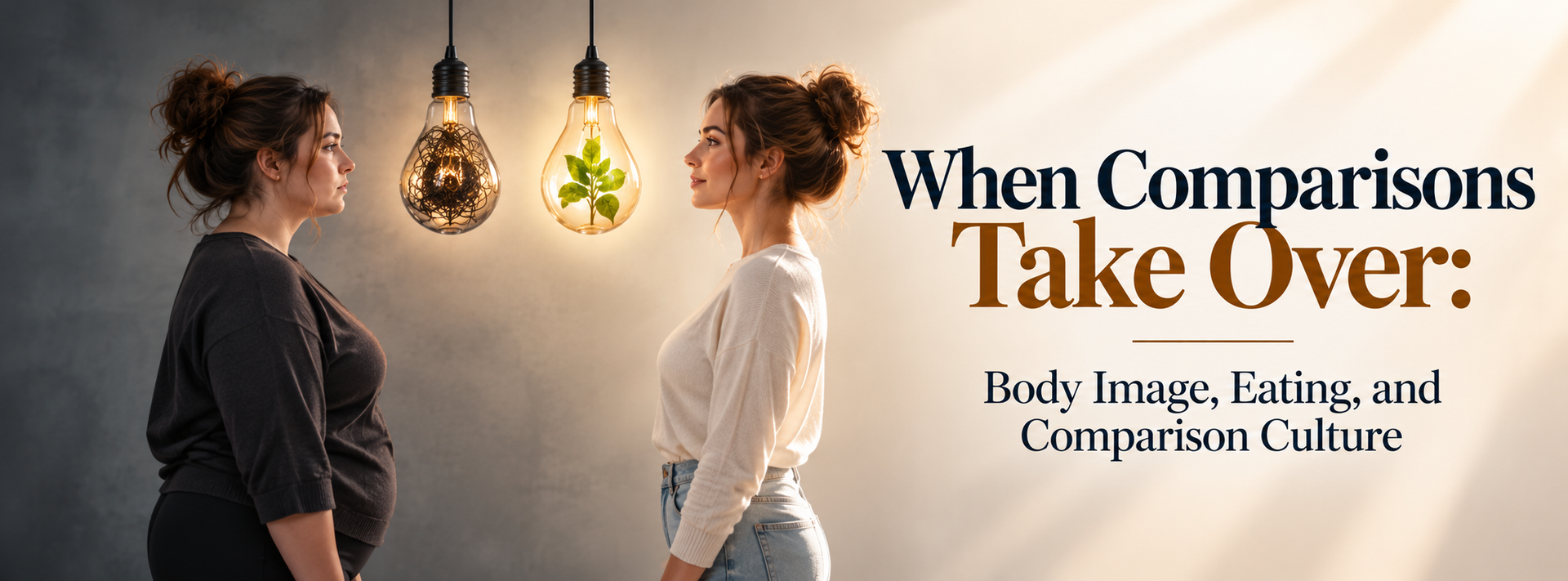
When Comparisons Take Over:
Body Image, Eating, and Comparison Culture
Being present in today’s society means noticing how easy it is for comparison to occur. Now with social media, we are constantly seeing everyone’s seemingly “perfect” lives with their routines, relationships, bodies, accomplishments, workouts, and everything in between. Although most of us are aware the social media is a highlight reel and does not show the full picture, it can still be difficult to remain cognizant in the face of comparisons. It is so easy to start thinking,
why don’t I look like that? Should I be exercising more?
Am I doing enough? With each post, scroll, and profile, these thoughts can begin to take up a lot of space in our minds and begin to shape the way we may view ourselves. Research is beginning to give us a clearer picture of how closely social comparisons and body image can be connected.
A 2025 systemic review and meta-analysis published in
Body Image
examined 83 studies involving more than 55,000 participants and found that greater online social comparison was associated with greater body image concerns and eating disorder symptoms, and lower levels of positive body image. These findings show a relationship between these experiences as opposed to proving social media comparison directly causes body image concerns and eating disorder symptoms. The research also found that the opposite direction between the correlations was found, that existing body image concerns correlated to people more likely engaging in comparisons.
How Comparison Can Affect Body Image
While comparisons are a normal human behavior, there is the potential for it to become harmful overtime when we use other people as a measure of our own self-worth. The same research has found that the repeated exposure to certain appearances can contribute to the internalization of unrealistic standards for ourselves. It can become easy to believe certain standards can be attainable when we see so much of something online, whether it be popular influencers or our own social circles.
However, for some people, this may begin to influence their relationships with food and exercise. The 2025 meta-analysis found that greater comparisons through social media were associated with greater eating disorder symptoms. It is important to note that comparison does not cause eating disorders or disordered eating on its own, but it can become part of a larger pattern. This is especially true with those already struggling with perfectionism, self-esteem, anxiety, or body dissatisfaction. For some folks, thoughts about needing to change their bodies may gradually turn into restrictive eating, rigid food rules, compensatory exercise, or any other behaviors that can interfere with physical and emotional well-being.
Stepping Outside of the Comparison Cycle
Stepping away from comparisons does not mean never noticing another person’s appearance or ever feeling insecure again. Instead, it can mean being more aware of your thoughts and leaning into curiosity rather than judgments towards those thoughts. You might start to ask yourself, what am I telling myself right now? Whose standard am I trying to meet? Is this helpful or am I trying to earn my worth in other ways? Do these thoughts align with my own goals and values? It is also very helpful to become more intentional about the content you consume and what kind of affect it has on your physical and emotional well-being. Noticing what conversations, accounts, or social environments consistently leave you feeling worse about yourself is a great first step towards tackling the comparison cycle.
The research reminds us that our relationship with our bodies is so much more than simply feeling a certain way about our appearance. Positive body image can involve appreciation, acceptance, respect, and developing a sense of self-worth that is not dependent on appearance. It can mean creating more space to value your body for reasons that have little to do with how it works. Our bodies are capable of so much, whether it be creating life as moms, pushing ourselves in the sport we love, finding rhythm or creativity in our movements, leading us through new adventures, and ultimately keeping us going day-to-day.
If comparisons, body image concerns, or eating behaviors are taking up a significant amount of space in your life, you do not need to navigate those processes alone. Therapy can provide a space to explore those patterns and begin building a relationship with yourself that is less defined by comparison, and rather grounded in your own values and well-being.
Research
Bonfanti, R. C., Melchiori, F., Teti, A., Albano, G., Raffard, S., Rodgers, R., & Lo Coco, G. (2025). The association between social comparison in social media, body image concerns and eating disorder symptoms: A systematic review and meta-analysis. Body Image, 52, 101841. https://doi.org/10.1016/j.bodyim.2024.101841